
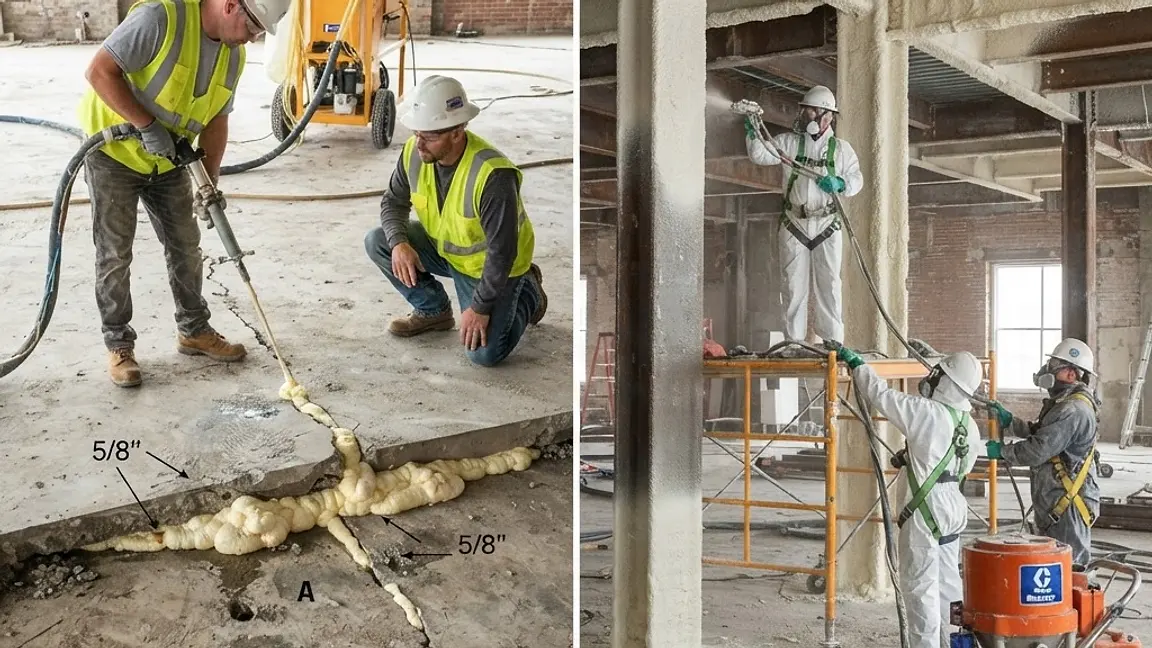
Spray foam has a reputation problem around mold that's mostly backwards — here's what actually causes it, and when foam is the fix rather than the cause.
This question comes up constantly, usually from someone who read a forum post about spray foam "trapping moisture and causing mold." The short answer: spray foam itself doesn't feed mold — cured polyurethane foam is not an organic food source the way wood, drywall paper, or cellulose insulation is. But the fear isn't entirely baseless, and understanding where it actually comes from matters if you're deciding whether foam is right for your project.
Mold needs three things: a food source, moisture, and the right temperature range. Closed-cell spray foam actually removes two variables from that equation in most applications — it's not an organic food source, and at 2 lb density it acts as its own vapour barrier, which, installed correctly, controls moisture movement through the assembly rather than inviting it in.
Where the real risk comes from is almost always installation error, not the material. The most common failure mode is spraying foam over a surface that's already wet or that has an active, unaddressed moisture source — a roof leak, plumbing leak, or rising damp — and sealing that moisture in rather than fixing the source first. Foam doesn't cause that mold; it was already present or already developing, and poor practice sealed it in rather than catching it. This is exactly why a competent crew checks and addresses moisture sources before spraying, not after.
The other failure mode is open-cell foam used in the wrong application. Open-cell is vapour-permeable by design, which is appropriate in some assemblies and genuinely wrong in others — used incorrectly in a location where it traps moisture against an organic material, it can contribute to a mold-friendly environment. This is a design and application decision, not a flaw in the product itself, which is part of why foam type and placement should be part of any real quote conversation, not an afterthought.
If you're dealing with a property that already has a mold problem, foam is not a cover-up solution. The moisture source has to be identified and the affected material addressed first — that's remediation, a distinct step from insulation, and skipping it just means sealing a problem behind a wall instead of solving it.
Done correctly — moisture source addressed first, the right foam type for the application, proper mix ratio and adhesion — spray foam is a tool that actively reduces mold risk by controlling moisture movement, not a cause of it. Done carelessly, like any building material installed over an unresolved problem, it can make a bad situation worse. The material isn't the variable that matters; the installer is.
Get a quote that spells out every line — foam type, thickness, R-value, and warranty.