
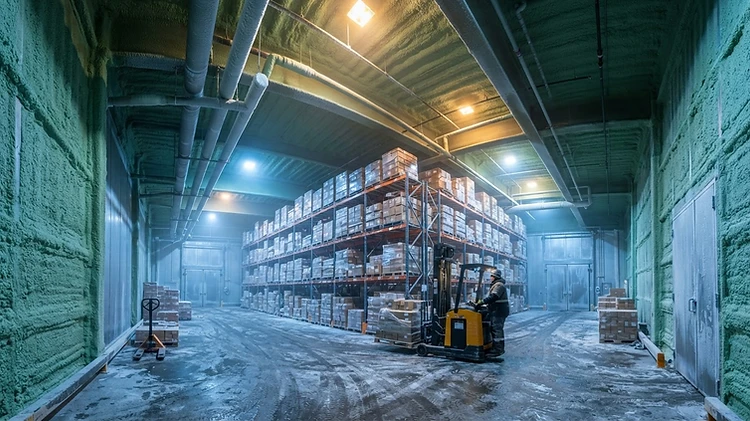
Freezers, reefer trailers, vans, and RVs all share one enemy: condensation. Open-cell foam traps moisture and rots the shell. Closed-cell is the only foam that belongs here.
Cold storage rooms, reefer trailers, walk-in coolers, vans, and RVs look like completely different projects, but from an insulation standpoint they're the same problem: a cold surface on one side of the foam and warm, moist air on the other. That temperature difference drives condensation, and condensation is what destroys these structures over time. Get the foam wrong and you get frost, mold, rust, and rot. Get it right and the envelope lasts for decades.
Open-cell foam has no place in any of these applications. Because it's vapor-permeable, moisture passes through it and condenses on the cold substrate behind it. In a freezer, that means ice builds up inside the wall. In a van, it means the steel or aluminum shell corrodes from the inside out. Open-cell is cheaper, and that's exactly why it shows up in bad vehicle and cold-storage builds — it lets the installer underbid everyone else, and the failure shows up two years later when the installer is gone.
Closed-cell foam (2 lb) is the correct product. It's a vapor barrier at 2 inches and above, so it stops moisture from reaching the cold surface entirely. It's dense enough to withstand the thermal cycling of a freezer or a vehicle on the highway. It adds rigidity to thin metal walls and roofs, which quiets road noise in vehicles and reduces flex cracking in trailers. And it gives the highest R-value per inch of any common insulation, which matters when you only have 2-3 inches of cavity to work with in a van wall or a freezer panel.
The other factor people miss is air sealing. In a cold storage envelope or a vehicle, it's not enough to insulate — every penetration, seam, and rim has to be sealed so warm humid air can't sneak past the foam and condense on a cold surface. Closed-cell foam does this in a single pass because it's both insulation and air barrier. That's why a properly sprayed closed-cell envelope outperforms rigid board and tape, which always has seams.
If you're quoting cold storage or a vehicle build, the spec should be closed-cell, 2 inches minimum, with every penetration sealed, and a written warranty. Anything less isn't a discount — it's a deferred failure you'll pay to fix later.
Get a quote that spells out every line — foam type, thickness, R-value, and warranty.