
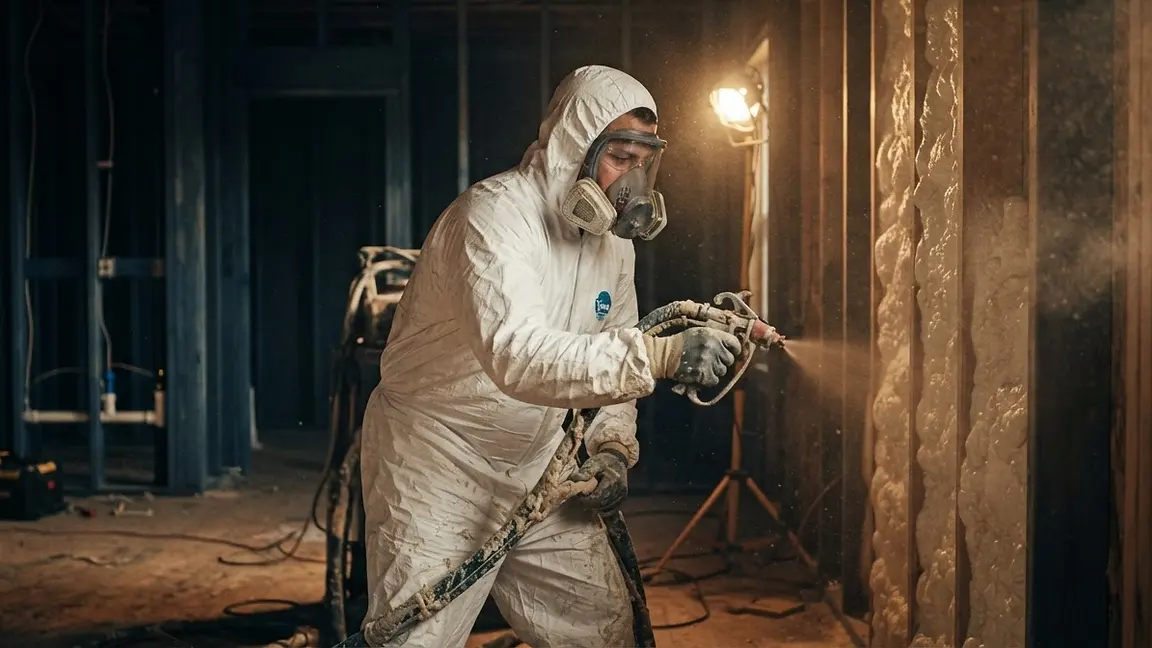
A realistic breakdown of what drives spray foam pricing in the GTA, so you can tell a fair quote from a lowball or an inflated one before you sign anything.
Every homeowner asking about spray foam wants one number. The honest answer is that there isn't one — spray foam pricing depends on enough variables that two quotes for seemingly similar jobs can legitimately differ by a few thousand dollars, and both can be fair.
Here's what actually moves the number. Closed-cell foam runs significantly more per board foot than open-cell, because it's a denser, higher-yield product that also acts as a vapour barrier. Thickness matters just as much as square footage — a quote covering 2 inches of closed-cell in an attic is a different job than one covering 4 inches, even on the identical roof. Access is another big one: a wide-open new-build attic sprays fast; a cramped, finished basement with obstructions, or a job requiring scaffolding or tight crawlspace work, takes longer and costs more in labour regardless of square footage.
For the GTA specifically, expect ballpark ranges in the neighbourhood of $1.25–$1.75 per board foot for open-cell and $1.50–$2.25 per board foot for closed-cell, though a reputable contractor should be quoting you in dollars for the whole job, not just handing you a per-board-foot number and leaving you to do the math. Treat any number given without a site visit or at least detailed photos and measurements as a rough placeholder, not a real quote.
What should make you suspicious: a quote that's dramatically cheaper than everyone else's, with no mention of foam type, thickness, or R-value. That's usually a sign of thin coverage, a lower-grade product, or a contractor planning to cut corners on prep work you won't see once the drywall goes up. On the other end, a quote with no breakdown at all — just one big number — makes it hard to know what you're actually paying for if you ever want to compare it to another bid.
A real quote should tell you the foam type, the thickness in inches, the resulting R-value, and whether a thermal or ignition barrier is included where code requires one. If a quote you've received doesn't include those details, it's worth asking for them before you decide based on price alone.
Government and utility rebate programs for insulation retrofits change fairly often in Canada — some have closed, others open up provincially or through local utilities. Rather than planning around a specific program here that might be out of date by the time you read this, check current eligibility directly with Natural Resources Canada or your utility provider before you budget around a rebate.
If you want a number you can actually use, the fastest honest path is our online estimator for a ballpark, followed by a real quote once we've seen the space.
Get a quote that spells out every line — foam type, thickness, R-value, and warranty.