
Spray foam isn't always the right call, and fiberglass isn't always the budget compromise people assume. Here's how to actually choose between them.
We install both spray foam and fiberglass, which means we don't have a reason to steer you toward the pricier option by default. The honest answer is that the right choice depends on the specific application, not on which product sounds more advanced.
Fiberglass batts and rolls are a mature, well-understood product. Installed correctly, to the right depth, in a standard stud or joist cavity, fiberglass delivers solid R-value per dollar and is faster to install, which keeps labour costs down. It's the right call for a lot of standard renovation and new-construction framing where budget matters and the cavity is a simple, regular shape.
Where fiberglass falls short is air sealing. Fiberglass insulates against heat transfer, but it doesn't stop air movement — gaps, bypasses, and penetrations around wiring, plumbing, and framing seams still let conditioned air leak out and outside air leak in, no matter how well the batts are installed. In a lot of homes, that uncontrolled air leakage accounts for more energy loss than the insulation's R-value alone would suggest.
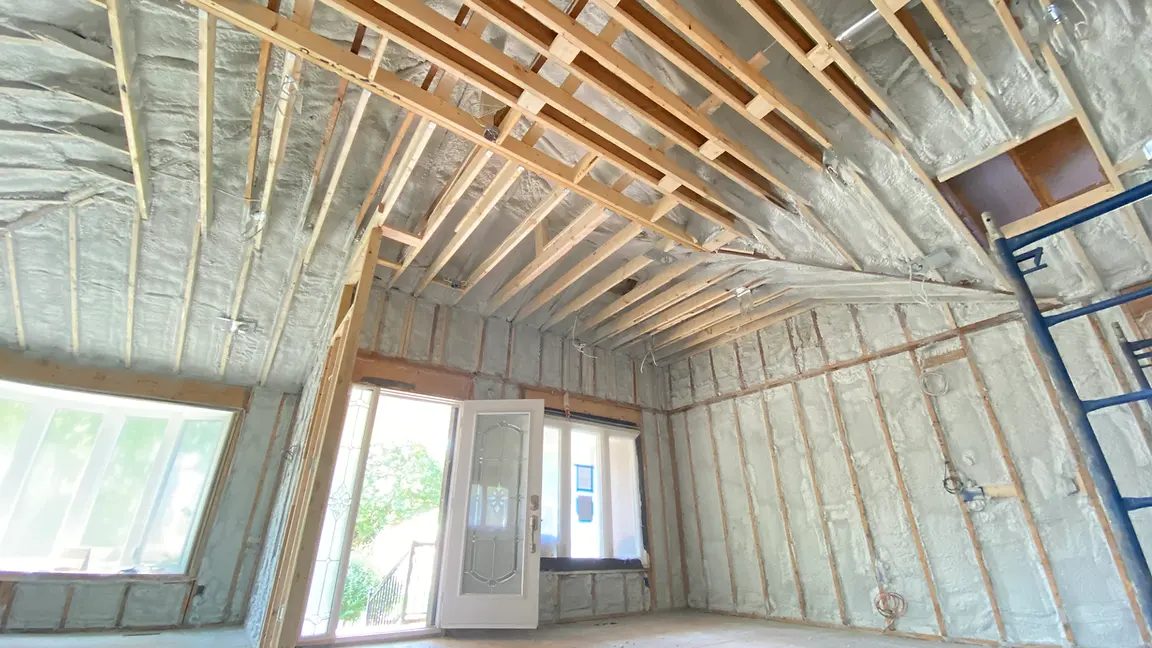
Spray foam, particularly closed-cell, solves the air sealing problem by expanding to fill every gap and irregularity in a cavity, sealing and insulating in a single pass. It also adds structural rigidity and, at 2 lb density, acts as its own vapour barrier — relevant for rim joists, basements, and anywhere moisture control matters as much as thermal performance. The tradeoff is cost: spray foam runs meaningfully more per square foot than fiberglass, and it requires a trained crew with calibrated equipment to install correctly.
In practice, a lot of the best-performing jobs we do aren't purely one or the other. Spray foam on a rim joist and irregular cavities, fiberglass in the open, regular-shaped stud bays above it, is a completely reasonable way to control budget while still getting air sealing where it matters most.
The question worth asking isn't "which insulation is better" in the abstract — it's "where in this specific building does air sealing matter enough to justify the cost difference, and where doesn't it." That's a conversation worth having with whoever's quoting your job, and if your current contractor only offers one product, you're not getting an unbiased answer to it.
Get a quote that spells out every line — foam type, thickness, R-value, and warranty.